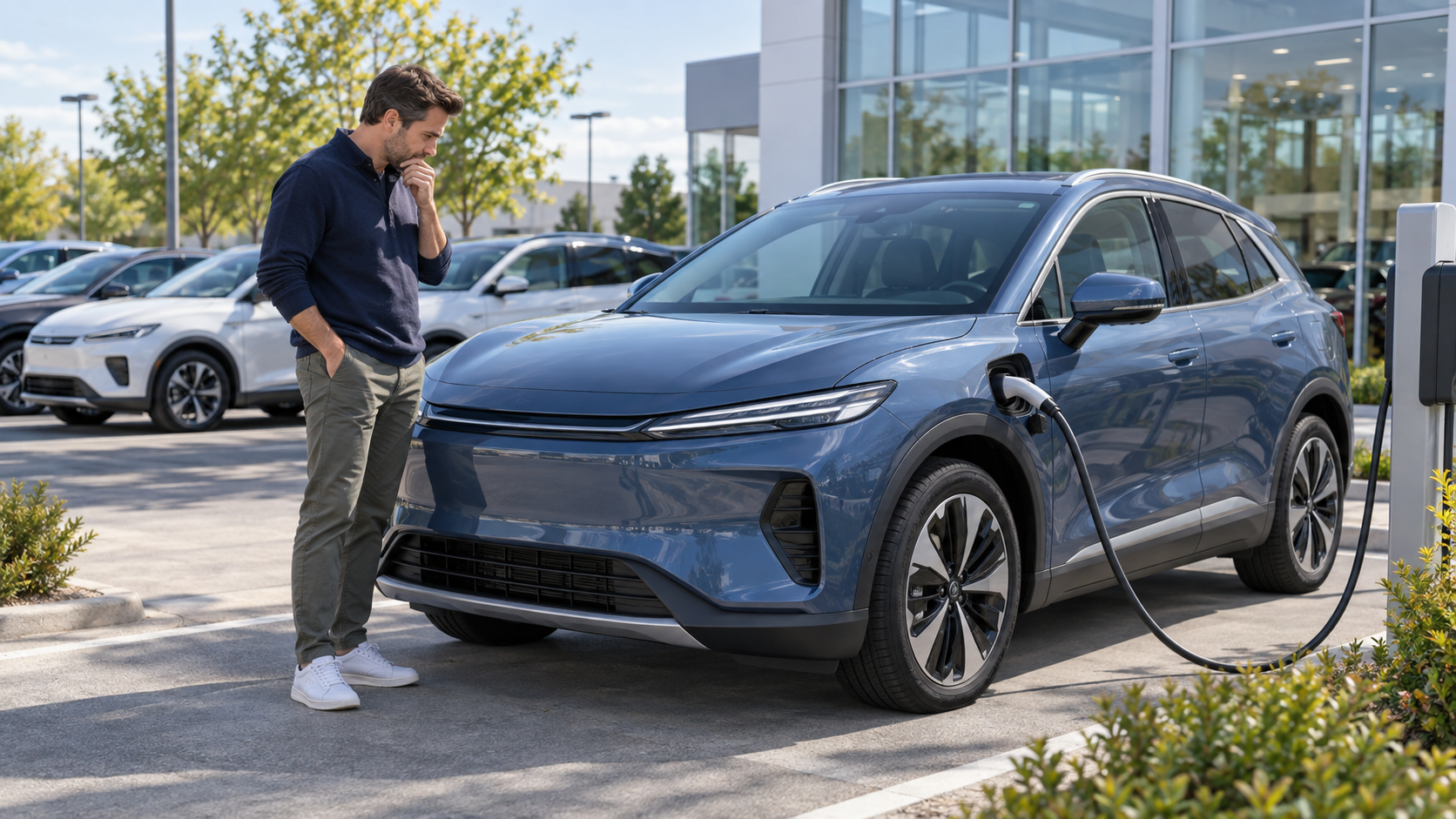
Is a Used EV Right for You? The Complete 2026 Guide
Used electric vehicles have become a realistic option for more car shoppers—but an EV isn't automatically the right choice for everyone.
A used EV can offer quiet performance, fewer routine engine-related maintenance items, convenient home charging, and potentially lower day-to-day energy costs. But buying one requires evaluating things you wouldn't normally consider when shopping for a gasoline-powered used car, especially battery condition, remaining range, charging access, charging speed, and battery warranty coverage.
So, should you buy a used EV in 2026?
A used EV may be a good fit if its real-world range comfortably covers your driving, you have convenient and affordable charging, the battery is in good condition, and the vehicle fits your total budget. If charging is difficult or you regularly drive beyond the vehicle's practical range, a hybrid or gasoline vehicle may be a better fit.
Here's what to evaluate before deciding.
1. Start With Your Driving Habits—not the EV
Don't begin with:
"Which EV should I buy?"
Begin with:
"How do I actually use my car?"
Think about a normal week.
Ask yourself:
How many miles do I drive each day?
How long is my commute?
Can I charge where I park overnight?
Do I regularly take long road trips?
What are winters and summers like where I drive?
How often do I need to tow or carry heavy loads?
Are public chargers available along the routes I actually use?
How long do I normally keep a vehicle?
If you primarily commute locally and can charge at home, an EV can be extremely convenient.
If you routinely travel long distances through areas with limited charging, your decision requires more planning.
The right EV isn't necessarily the one with the longest advertised range. It's the one with enough usable range for your real life.
2. Battery Health Is One of the Most Important Things to Check
A used EV's high-voltage battery deserves special attention because its condition directly affects usable driving range and potentially the vehicle's long-term value.
EV batteries gradually lose capacity with age and use. But degradation isn't identical from one vehicle to another.
Battery condition can be influenced by factors including:
Vehicle age
Mileage
Battery chemistry
Temperature exposure
Charging habits
Thermal-management system
How the vehicle was used
That's why you shouldn't assume that every three-year-old EV has the same percentage of its original capacity remaining.
And you shouldn't automatically buy or reject an EV based on one battery-health percentage.
Instead, evaluate the battery in the context of the specific model, age, mileage, original range, current usable range, diagnostic information, and remaining warranty coverage.
What should you ask about a used EV battery?
Before buying, try to determine:
What was the vehicle's original EPA-rated range?
What range does it provide under current conditions?
Is battery-health information available?
Are there battery-related warning messages?
Has the battery ever been repaired or replaced?
Is any original battery warranty still active?
What does that warranty actually cover?
A qualified inspection or model-appropriate battery diagnostic can provide useful information that a conventional test drive may not reveal.
3. Don't Confuse Dashboard Range With Battery Health
This is an easy mistake to make.
If an EV displays 180 miles of estimated range when fully charged, that doesn't necessarily tell you precisely how much battery capacity has been lost.
The displayed range estimate can change based on factors such as:
Recent driving behavior
Highway versus city driving
Outside temperature
Climate-control use
Terrain
Vehicle load
Software calculations
Treat the dashboard estimate as useful information—not a complete battery-health report.
When evaluating a used EV, combine available battery information with the vehicle's history, physical condition, diagnostic results, warranty status, and a proper test drive.
4. Your Real-World Range Will Not Always Match the Advertised Number
EPA range is a useful comparison point, but your actual driving range can vary.
Cold temperatures, high speeds, cabin heating or air conditioning, hills, towing, aggressive driving, and other conditions can affect energy consumption.
For used vehicles, battery degradation can reduce available range further.
That's why buying an EV with exactly enough advertised range for your commute leaves little margin.
Suppose your normal driving requires 60 miles per day. An EV that comfortably handles that distance under the conditions you regularly experience may be practical even if it doesn't have the longest range in its class.
On the other hand, if you routinely drive hundreds of miles in one day, charging speed and charger availability may matter as much as total range.
5. Home Charging Can Completely Change the Ownership Experience
For many EV owners, the biggest advantage isn't avoiding gas stations.
It's waking up with a charged vehicle.
If you can reliably charge where you live, an EV can become much easier to own.
There are two common home-charging approaches.
Level 1 charging
Level 1 generally uses a standard household electrical outlet.
It's relatively slow, but depending on your daily mileage and vehicle, overnight charging may replenish enough energy for your normal driving.
Level 2 charging
Level 2 charging uses higher-voltage equipment and can charge considerably faster.
For drivers who cover more miles each day, having appropriate Level 2 charging at home can make EV ownership much more convenient.
Before buying, however, don't assume installation will be simple or inexpensive.
Check:
Whether you own or rent
Where you park
Electrical-panel capacity
Charger location
Installation requirements
Equipment and electrician costs
Utility electricity rates
Get an installation estimate if necessary before buying the car.
6. If You Can't Charge at Home, Do the Math First
You don't necessarily need home charging to own an EV.
But the experience can be very different.
If you live in an apartment, park on the street, or cannot install charging equipment, determine where you would actually charge.
Look at chargers near:
Home
Work
Grocery stores
Shopping areas
Your regular routes
Frequent road-trip destinations
Then investigate:
Charging speed
Pricing
Reliability
Connector compatibility
Network requirements
How long you'd typically need to stay
Don't buy an EV based on a map showing a charging station somewhere nearby.
Build a realistic charging routine first.
If your plan feels inconvenient before you've even purchased the car, pay attention to that.
7. Charging Speed Matters More Than Many First-Time EV Buyers Realize
Not all electric vehicles charge at the same speed.
And not all charging stations deliver the same power.
Two EVs with similar driving ranges can provide very different road-trip experiences if one can replenish its battery significantly faster.
When comparing used EVs, investigate:
AC/home charging capability
DC fast-charging capability
Maximum charging rate
Typical charging curve
Compatible charging connectors
Whether an adapter is required
Access to charging networks you expect to use
This matters particularly if you plan to rely heavily on public fast charging.
For a commuter who charges overnight, maximum DC charging speed may rarely matter.
For a frequent interstate traveler, it can be one of the most important specifications.
8. Check the Battery Warranty—Carefully
One of the most valuable pieces of information on a used EV may be its remaining battery warranty.
But don't assume every manufacturer provides identical coverage.
Warranty duration, mileage limits, capacity-loss provisions, exclusions, transferability, and other conditions can differ by manufacturer, model, model year, and sometimes jurisdiction.
Before buying, confirm:
Original in-service date
Current mileage
Remaining battery warranty
What components are covered
Whether degradation is covered
The manufacturer's threshold for a capacity-related warranty claim, if applicable
Whether the warranty transfers to a subsequent owner
Whether previous repairs affect coverage
Don't rely on a statement that the car "still has a battery warranty."
Find out exactly what that warranty means for the particular vehicle you're considering.
9. EVs Still Need Maintenance
Electric vehicles eliminate several maintenance items associated with internal-combustion engines.
There are no conventional engine-oil changes, spark plugs, or engine timing belts on a battery-electric vehicle.
But an EV is not maintenance-free.
Depending on the model, you'll still need to consider:
Tires
Tire rotations
Wheel alignment
Brakes
Suspension
Cabin air filters
Wiper blades
Air conditioning
Cooling systems
12-volt battery
Manufacturer-recommended inspections and fluids
Pay particular attention to the tires
EVs can be heavy and produce strong instant torque. Tire condition should therefore be part of your used-EV inspection.
Check tread depth, uneven wear, tire age, alignment symptoms, and the cost of replacement tires appropriate for that particular vehicle.
A used EV with four tires approaching replacement may have an immediate ownership expense worth factoring into the purchase decision.
10. Insurance Should Be Part of Your Comparison
Don't assume an EV will cost the same to insure as your current vehicle.
Insurance premiums depend on many variables, including the driver, location, vehicle, coverage, insurer, repair costs, and claims history.
Before purchasing a specific EV, get an insurance quote using the actual year, make, model, and trim you're considering.
Do this before signing—not afterward.
A vehicle that saves money on electricity could still be more expensive overall if another ownership expense increases substantially.
11. Calculate Charging Cost Instead of Assuming Electricity Is Cheap
One of the biggest potential financial benefits of an EV is lower energy cost per mile.
But whether you actually save money depends on where and how you charge.
Home electricity rates can differ from public charging prices. Some utilities also offer time-of-use rates where electricity prices change depending on when you charge.
Public DC fast charging can cost considerably more than charging at home.
So don't compare:
Gas price vs. electricity price
Compare:
Total energy cost per mile for the gasoline vehicle vs. total electricity cost per mile for the EV under your actual charging routine.
Then add insurance, maintenance, financing, registration, tires, and expected depreciation to get a better picture of total ownership cost.
12. Don't Count on a Federal Used-EV Purchase Credit in 2026
This is particularly important because older used-EV guides can now be misleading.
The federal Previously-Owned Clean Vehicle Credit that previously provided eligible buyers with a tax credit on qualifying used clean vehicles is not available for vehicles acquired after September 30, 2025.
So if you're purchasing a used EV in 2026, don't build your budget around receiving that former federal used-vehicle credit.
Other incentives, utility programs, charging programs, or state/local benefits can change and may depend on where you live, so verify current programs before making your purchasing decision.
13. Inspect a Used EV Like a Used Car—Plus an EV
Battery health shouldn't distract you from everything else.
A used EV is still a used vehicle.
Review its history and inspect the same fundamental areas you would on any other car:
Accident history
Title status
Mileage
Tires
Brakes
Suspension
Steering
Body condition
Interior condition
Electronics
Climate control
Warning lights
Charging equipment
Then add EV-specific checks:
High-voltage battery condition
Battery warranty
Charging-port condition
AC charging
DC fast charging
Charging cables/adapters
Thermal-management system
EV-related warning messages
Software features and subscriptions where relevant
A vehicle history report can be useful, but it shouldn't replace an appropriate physical inspection.
14. Take a Real Test Drive
EVs often feel smooth and quiet, which can make a short test drive impressive.
Go beyond that initial impression.
Test:
Acceleration
Braking
Regenerative braking
Steering
Highway behavior
Ride quality
Road and suspension noise
Climate control
Driver-assistance features
Infotainment
Charging-port operation when practical
Listen for suspension noises and pay attention to vibrations, pulling, unusual tire noise, or warning messages.
Most importantly, determine whether you actually like how the vehicle drives.
15. Think About Your Road Trips Before You Buy
Daily commuting and road trips are two different EV use cases.
A used EV may cover your commute effortlessly while requiring more planning on a 500-mile trip.
If long-distance travel matters to you, research a typical trip before purchasing.
Consider:
Your Route → Available Chargers → Vehicle's Realistic Highway Range → Charging Speed → Charging Stops → Destination Charging
If the result fits your lifestyle, great.
If it looks frustrating, consider a different EV, a plug-in hybrid where appropriate, a conventional hybrid, or a gasoline-powered vehicle.
The goal isn't to convince yourself to buy an EV.
It's to buy the powertrain that works for you.
Used EV vs. Hybrid vs. Gas: Which One Fits You?
A simple way to narrow the decision is to think about your everyday use.
Your Situation
Worth Considering
Short/moderate commute + reliable home charging
Used EV
Lots of local driving + convenient charging
Used EV
Long commute but adequate EV range + home charging
Used EV
Apartment/no reliable charging
Hybrid, gas, or an EV after careful charging planning
Frequent long-distance travel
Long-range/fast-charging EV, hybrid, or gas
Want improved fuel economy without charging
Conventional hybrid
Want some electric driving plus a gas engine
Plug-in hybrid, depending on use
Lowest purchase price is the main priority
Compare used EV, hybrid, and gas options based on actual local inventory
These aren't universal rules. They're a starting point for matching the technology to your lifestyle.
Questions to Ask Before Buying a Used EV
Before you sign, get answers to these questions:
What was this model's original EPA-rated range?
What battery-health information is available?
How much usable range should I realistically expect?
Is the original battery warranty still active?
What exactly does that warranty cover?
Has the battery been repaired or replaced?
What charging connectors does the vehicle use?
How quickly can it charge at home?
How quickly can it DC fast charge?
Are the charging cable and relevant adapters included?
What condition are the tires and brakes in?
What will this specific vehicle cost to insure?
Can I conveniently charge it where I live?
Does its range work for my longest regular trips?
Does the complete purchase and ownership cost fit my budget?
If you can't confidently answer the questions that matter to your situation, gather more information before buying.
So, Is a Used EV Worth It in 2026?
For the right driver, absolutely.
But "right driver" is the important part.
A used EV can make a lot of sense when:
You have reliable charging
Its realistic range exceeds your normal driving needs
The battery is in appropriate condition
Remaining warranty coverage is understood
Insurance is affordable
The purchase price fits your budget
Your regular long-distance travel works with the vehicle's charging capabilities
You may want to consider another type of vehicle if:
Reliable charging would be difficult
Your routine trips push the limits of the vehicle's usable range
You frequently travel routes with inconvenient charging
Insurance or other ownership costs erase the expected savings
The battery condition or history can't be adequately evaluated
The smartest purchase isn't automatically an EV, hybrid, or gasoline vehicle.
It's the vehicle that best fits your driving, charging access, budget, and ownership plans.
Shopping for a Used Vehicle in Fredericksburg, VA?
If you're deciding between an electric vehicle, hybrid, and conventional gasoline vehicle, start by comparing the vehicles that actually fit your needs and budget.
MY CAR helps Fredericksburg-area shoppers explore pre-owned vehicles and financing options for different credit situations.
Ready to compare vehicles? Browse MY CAR's current used-vehicle inventory.
Want to understand your financing options first? Start the prequalification process before choosing your next vehicle.
Compare the vehicle, battery or powertrain, ownership costs, financing, and how it fits your everyday life—then choose the option that makes the most sense for you.
View Inventory → Compare Your Options → Find Your Next Vehicle